Two neutered 3-year-old Persians sit in the same row of any Persian cat diet chart by age. One has an ideal weight of 4 kg (8.8 lb) and needs about 240 kcal (what labels call calories) a day. The other, a big male at 5 kg (11 lb), needs about 280. That’s roughly half a can a day, every day, that a chart can’t see.
The short answer: a neutered adult Persian with an ideal weight of 3-5.5 kg (6.6-12 lb) needs roughly 190-300 kcal a day. That’s about 2½ to nearly 4 cans of 80-kcal wet food before treats. For adults, ideal weight moves the number more than age does.
Here’s how to work out your cat’s number across four life stages, built on two checks:
- Weight, tracked monthly
- Body condition, checked by hand
Every number here is a starting point, and I’ll flag where bowl shape, texture and teeth change how you feed a flat-faced cat. Start with the table below, then find your cat’s stage. I’m Rafayet Rabbi, founder of Cats Question. I write this with a background in veterinary education and years of hands-on cat care.
How Much Should a Persian Eat?
A chart gives a starting range, but how much to feed a Persian cat is really a calorie target. If her ideal weight is in the diet chart, read her number there. If it isn’t, here’s the math, using a 4 kg (8.8 lb) neutered adult as the example:
- Find resting energy: 70 × (ideal kg)^0.75. On a calculator, type her ideal weight, press √ twice, then divide the weight by that result. For 4 kg, that’s 4 → 1.41, and 4 ÷ 1.41 = 2.83.
- Multiply by 70 to get about 198 kcal at rest.
- Multiply by about 1.2 for a neutered adult (about 1.4 if intact). That’s her daily calories: roughly 238 for this cat.
Use ideal weight, not current weight, or you’ll feed the excess. Your vet sets the target, but here’s a rule of thumb for finding it. On the 9-point body condition scale, 4-5 is ideal, and each point above 5 means roughly 10-15% over ideal weight. A 5 kg Persian scoring 7/9 is about 20-30% over, so her ideal is closer to 3.9-4.2 kg. She’s a 4 kg cat in a 5 kg coat.
Then split the day’s calories. Keep about 24 kcal (10%) for treats and put the other 214 into meals, which is about 2⅔ cans at 80 kcal. Prefer half wet, half dry? That’s about 107 kcal wet (1⅓ cans) plus about 107 kcal dry (a bit over ¼ cup at 100 kcal per ¼ cup). Swap in the kcal-per-can and kcal-per-cup figures from your own label, and keep treats at or under 10%.
Is my Persian overweight? Fluff lies. A thick coat hides extra weight and lost muscle, so part it and check by hand. Her ribs should feel like the back of your hand with the fingers flat, not like your palm. From above you should see a waist behind the ribs, and from the side a tuck rather than a hanging belly pad.

Related Cat Articles
Why Is My Cat Losing Weight but Still Eating? Signs, and Fixes
Wet, Dry or Both? What a Flat Face Changes

For most Persians, wet food makes the better foundation. It’s roughly 75–80% moisture versus about 10% for dry, and it’s harder to overfeed a can than a scoop. Dry works as a measured extra.
Kibble isn’t a toothbrush. A short muzzle crowds the teeth, and the products shown to reduce plaque or tartar are the ones accepted by the Veterinary Oral Health Council (VOHC), meaning they met its standard in testing. “Persian-shaped” kibble is a manufacturer claim, and as far as I know no independent study shows the shape helps.
To test it on your own cat, put 10 pieces of each shape on a plate, count the clean pickups, and repeat over three days. Brushing does more than any shape. Use cat toothpaste, let her lick it off your finger first, and build up to brushing a few times a week. Before any dental work, ask your vet how anesthesia is managed for a flat-faced cat.
At the bowl, watch for:
- Walking to the bowl, sniffing, then backing away
- Food pushed out or dropped
- Chewing sideways or on one side
- Very long meals
- Swallowing kibble whole, or going off dry food
- Drooling or bad breath
Any of these can mean dental pain rather than fussiness, so they deserve a vet look. A few feeding habits come from experience rather than studies, so try each and see what your cat does:
- A wide, shallow plate instead of a deep bowl, so her face isn’t pressed against the rim.
- Pâté over chunks in gravy, since chunks are what tend to get pushed out.
- Warming wet food for a few seconds. A stuffy nose blunts smell. Stir it and check that it’s lukewarm, not hot.
- Wiping her facial folds after meals.
Dry also hides calories. On a 238 kcal day, one small scoop (about 100 kcal per ¼ cup) holds more calories than a whole 3 oz can (about 80 kcal), roughly 40% of her daily calories. Weigh dry food in grams, since scoops vary. Start wet, scoop dry sparingly, and weigh her monthly.
Do Persian Cats Need Special Food?
No. A Persian does fine on any complete and balanced cat food, and the breed name on the front matters less than the back of the bag. The exception is a vet finding a reason, such as kidney disease, urinary stones, allergy, GI disease or a weight-loss plan. Breed formulas mostly tweak fiber, fatty acids and calorie density, so treat those as manufacturer claims.
On the back of the bag, check:
- The adequacy statement. Look for the Association of American Feed Control Officials (AAFCO) statement in the US or the European Pet Food Industry Federation (FEDIAF) statement in Europe. It should name a profile: growth (or all life stages) for kittens, adult maintenance (or all life stages) for adults. AAFCO has no senior profile, so “senior” on the front is marketing.
- How the claim was proven. “Animal feeding tests using AAFCO procedures” means the food was fed to cats in a trial. “Formulated to meet” means the recipe matches the nutrient tables on paper. Both are legal wordings, but the feeding test is the stronger evidence.
- Kcal per can or cup, and named protein sources.
- Cost per 1,000 kcal.
That last one beats price per kg, because a kilo of wet food is mostly water. A 2026 retail sample of 100 products found dry cat food averaging about $3.17 per lb and 3 oz wet cans about $8.35 per lb. For our 4 kg cat’s month (238 kcal × 30 days = 7,140 kcal), that works out to:
| Food | Cost per 1,000 kcal | Cost for the month |
| Dry (about 3,600 kcal/kg) | about $1.94 | about $14 |
| Wet, 3 oz cans (80 kcal each) | about $19.60 | about $140 |
Per pound, wet looks about 2.6 times dearer than dry. Per calorie, it’s about 10 times. Half wet, half dry lands near $77. The 80 kcal can and 100 kcal per ¼ cup figures in this guide are round examples, and prices vary by market, so run the same sum with your own label and shelf price (price per can ÷ kcal per can × 1,000).
Related Cat Articles
Feeding a Persian Kitten From 8 to 16 Weeks
For a Persian kitten new to your home, week one means change nothing. Ask the breeder what, how often and how much, then buy that same food. Rehoming stress alone can loosen stools, so a soft stool isn’t automatically the food’s fault. If it hasn’t firmed up in a couple of days, bring a fresh stool sample to the vet, since parasites are a common cause. If you must switch foods, mix over 7–10 days.
Eight weeks is a common age for rescue kittens, but many reputable Persian breeders keep kittens until about 12 weeks, and some breed clubs set 13 as the minimum. If yours is older, nothing below changes. You just start the math at her current weight.
After week one, feed by calories: resting energy × about 2.5, split into 3–4 small meals. For a kitten, use today’s weight, not an ideal weight, and redo the sum every two weeks.
A 1 kg kitten needs about 175 kcal a day. Over four meals that’s 44 kcal each, a bit under half a 3 oz (85 g) can at 95 kcal. By 2 kg, the same sum gives about 295 kcal, which is why a chart from last month is already out of date.
- Weigh weekly, on the same scale at the same time of day, and write it down. A growing kitten should gain every week. Any loss, or no gain across a weekly weigh-in, is a reason to call the vet, especially with lethargy or a poor appetite.
- Call the vet that day if she skips two meals in a row, or has any vomiting or diarrhea with lethargy. Kittens under about 3 months can’t regulate blood sugar well, so a kitten who is wobbly, trembling or collapsed is an emergency, not a next-day call.
- A stuffy nose can stop a flat-faced kitten from eating, because she can’t smell her food. The flat-face feeding habits apply from day one, and two skipped meals is still the same-day call.
Months 4–12: Growth, Teething and the Spay/Neuter Switch
Between 4 and 12 months, a Persian’s calorie target changes when growth slows, again after spay/neuter, and once more when she moves to adult maintenance. Body condition and the surgery date set the timing, and the ages below are rough guides.
- Growth slows (about 4 months). Many references step the growth factor down from × 2.5 to about × 2.0. For a 3 kg kitten, that’s about 400 kcal a day falling to about 320.
- Meals. Three a day from about 4 months, then two from about 6.
- Teething (about 4–6 months, sometimes closer to 7). Sore gums can dent appetite, so offer softer food, such as wet food or kibble soaked in water. Ask your vet to check for retained baby teeth before the spay/neuter, so any extraction happens under the same anesthetic. A retained tooth in a young cat can cause the same signs as dental pain.
- Spay/neuter. Appetite rises while energy needs fall, so the same bowl becomes a surplus. That 3 kg kitten at about 320 kcal steps down toward roughly 190–240 after surgery, so the old portion is 80–130 kcal too much, about 1 to 1½ extra cans of 80-kcal wet food a day.
- On surgery day, recalculate and start near the top of that range (about 240), then trim by body condition.
- Weigh her weekly for six weeks. Growth looks like a longer, taller kitten with ribs still easy to feel. Fat looks like rounding, a lost waist and ribs that are harder to find.
- Adult food (around 12 months). Switch with the same 7–10 day mix as above. If she’s gaining fast before then, trim the portion first and ask your vet whether to move to adult food early.
Related Cat Articles
Adult Persian Feeding (1-6 Years): Weight, Meals and Kidney Habits
Most adult Persians do well on two or three measured meals at the same times each day. Any dry portion goes in a puzzle feeder and counts inside her daily calories, because free-feeding hides appetite changes. Deep puzzle feeders can frustrate a flat face, so test a shallow one first. If she vomits yellow foam before breakfast, a small late snack may help, but see your vet if it keeps happening.
Weigh her monthly, on the same scale at the same time of day, such as before breakfast. Use a baby or kitchen scale, since a bathroom scale can’t show a 100 g change. A hypothetical 4 kg neutered cat gaining 100 g a month is 10% heavier by month four. Catch the first 100 g, and a trim of about 5–10% is enough, roughly 12–24 kcal on 238. Agree on the trigger with your vet.
Already overweight? Have your vet set a target weight, feed to the calorie number for that ideal weight, and aim for slow loss of about 0.5–2% of body weight a week. That’s 20–80 g a week for a 4 kg cat. Faster loss risks fatty liver disease in cats.
As far as I know, no study shows that wet food or extra water bowls prevent kidney disease in cats. These habits support hydration and help you catch trouble early:
- A solid share of wet food in the diet.
- Two or three wide water bowls, away from her food and the litter box.
- A vet exam at least once a year. AAHA and AAFP recommend annual exams for every adult cat.
- Her PKD result. PKD is polycystic kidney disease, an inherited condition and a known Persian concern. Ask the breeder for the result. Adopted, or no result? Ask your vet about a PKD1 DNA test or a kidney ultrasound.
- A talk with your vet about when baseline bloodwork and urinalysis should start.
Straining in the litter box, or passing tiny amounts of urine or none at all, is an emergency, not a next-day call.
Senior Persian Cat Food (7+): Protect Muscle, Watch the Scale
The 2021 AAHA/AAFP guidelines call ages 7–10 “mature adult” and anything over 10 “senior.” A senior in excellent condition can be treated as a mature adult at the vet’s discretion. For both stages, start from the adult number (resting energy × about 1.2), then let the scale and her muscle decide.
7–10: Keep the Scale Steady
Weight control still matters. Keep the monthly weigh-in, and expect kidney and dental screening to be part of her vet visits now.
Over 10: Appetite, Muscle and Calorie Density
A senior Persian who is losing weight has a symptom, not an age. Picture a 12-year-old sliding from 4.2 kg to 3.8 kg in three months (about 10%) while her bowl empties daily. Unlike dogs, cats don’t need fewer calories as they age, and many past about 12 need more.
Once she’s losing weight, weigh her every two weeks. Also run your hands along her spine and hips. Vets call this a muscle condition score, and knobby bones under a thin covering mean muscle loss, which can happen even at a stable weight. Call your vet in any of these cases:
- Eating more but losing weight: this is the classic hyperthyroid or diabetes pattern, so see the vet this week.
- Eating less and losing weight: this is the classic dental or kidney pattern, and PKD makes kidneys a Persian concern. See the vet this week.
- No food for a full day: call that day, because cats who stop eating can develop fatty liver disease.
On the label, look for a named animal protein first and a kcal-per-can figure that lets small meals still reach her number. Healthy seniors need protein, not less. Digestion of fat and protein gets less efficient with age, so unnecessary restriction can cost muscle. Renal diets are for vet-diagnosed disease, never “just in case.” If kidney disease is diagnosed, your vet picks the diet, and phosphorus is the key number.
A sample day for that 12-year-old, aiming for her old 4.2 kg weight: about 245 kcal, as four warmed meals of about 60 kcal each, roughly ¾ of an 80 kcal can per meal. If she’s still losing, your vet may raise the number.
Related Cat Articles
Can Persian Cat Eat Rice? Portions, Prep & the Kidney Factor
Hairballs, Tear Stains, Weight and Loose Stools: Food or Vet?
Sort the symptom before you change the bowl.
| Symptom | First move | See the vet when |
| Hairballs | Brush her first. Fiber and fat tweaks have only modest evidence. | Same day: repeated retching with nothing coming up, lethargy, refusing food, or a swollen, painful belly |
| Tear stains | Wipe daily with a soft damp cloth. They’re mostly down to face shape and tear drainage, not food, so skip the powders. | The discharge is new or one-sided. A vet rules out blocked ducts, eye injury and infection. |
| Weight gain | Confirm with the hands-on score, trim calories, and keep loss slow, at the pace covered above. Crash diets risk fatty liver. | She’s gaining despite measured meals |
| Loose stools | Food, stress and parasites look alike, so bring a stool sample. | Longer than about 2 days in an adult (about 1 day in a kitten), or with blood, lethargy or repeated vomiting |
Whatever the symptom, straining in the litter box or passing little or no urine is a same-day emergency.
Picture a Persian with stained cheeks and soft stool who is fed three different foods in a month. Every switch muddies the picture, while an eye exam and a stool sample answer it. A symptom that lasts past the thresholds above is a vet question before it’s a diet change. Thinking of cooking for her? That’s next.
Homemade and Raw Diets: What’s Safe, What Isn’t
Homemade food is safe for a Persian only when a board-certified veterinary nutritionist wrote the recipe for cats and you follow it exactly. A UC Davis analysis of 114 homemade cat recipes from books and websites, written by vets and non-vets alike, found that none of the 94 with enough detail to analyze met all of the National Research Council’s recommended allowances for adult cats. Some were short on up to 19 essential nutrients (JAVMA, 2019). Even the five that came closest, all vet-written, missed at least one.
Daily boiled chicken and rice fails for the same reason. She eats eagerly and looks fine while gaps build. A taurine shortfall can damage the heart muscle and eyes, and a calcium shortfall can weaken bones, especially in kittens.
Want to cook anyway? Ask your vet to refer you to a board-certified veterinary nutritionist (ACVN’s directory is at acvn.org/directory, and ECVCN covers Europe). The recipe is a package: no swaps, no skipped supplements, and a yearly recheck, because supplements and needs change.
Related Cat Articles
Toxic Items and “Kind” Foods That Backfire
Start with the foods worth memorizing, and do a quick audit of your counters and table for them.
| Item | Why it matters |
| Onion, garlic, chives (also hiding in baby food, broths and sauces) | Can damage red blood cells |
| Chocolate, caffeine | Stimulants that affect the heart and nervous system |
| Alcohol | Even a small amount can hit a small cat hard |
| Xylitol, grapes, raisins | Proven toxic in dogs. The cat evidence is thinner, but treat them as toxic. |
| Lilies (true lilies and daylilies, vase water included) | Can cause kidney failure in cats |
If she eats any of these, call your vet or a poison line right away. In the US, that’s ASPCA Animal Poison Control (888-426-4435) or Pet Poison Helpline (855-764-7661). Both charge a consultation fee. Don’t induce vomiting unless you’re told to.
The more common daily problem is “kind” food:
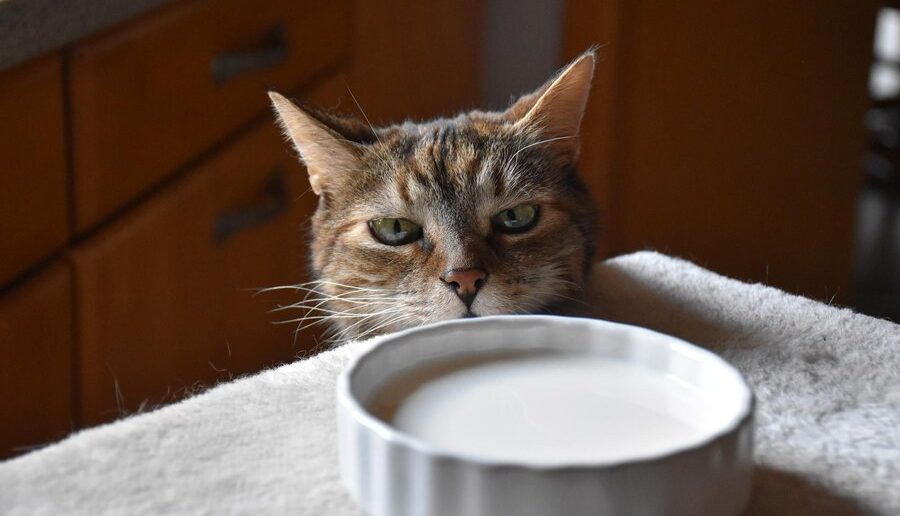
- Cow’s milk: it often loosens stools, since many adult cats digest lactose poorly. A hypothetical 50 ml saucer is about 30 kcal, already past a 4 kg neutered Persian’s 24 kcal treat allowance.
- Tuna as a staple: it isn’t complete, and tuna-heavy diets can cause steatitis, a painful inflammation of body fat linked to low vitamin E.
- Dog food as a staple: it isn’t built for a cat’s needs, taurine among them. A single dog-food meal in a pinch isn’t an emergency. Making it the diet is.
- Cooked bones: they can splinter.
- A bag marked “for intermittent or supplemental feeding only”: that wording means it isn’t a complete diet. It’s a topper, not a diet, so keep it inside the 10% allowance.
Your First Week: Five Steps and a Vet-Visit Card
A Persian cat diet chart becomes your cat’s plan once you put her numbers in. Five steps this week:
- Weigh her. If she hates the scale, weigh yourself holding her, then alone, and subtract. For monthly tracking, switch to a baby or kitchen scale, which reads in 5–10 g steps.
- Score body condition by hand: ribs, waist from above, belly pad. Use the score to set her ideal weight with the rule from the calorie section, and check it against our weight chart by age.
- Calculate calories: 70 × (ideal kg)^0.75 × her factor. Kitten up to about 4 months: × 2.5. Kitten 4–12 months: × 2.0. Neutered adult: × 1.2. Intact adult: × 1.4. Use today’s weight for a kitten and ideal weight for an adult.
- Check the label: adequacy statement, kcal, named protein and cost per 1,000 kcal.
- Set meal times and book a re-weigh in 2–4 weeks.
Then take your vet a one-card summary: target weight, body score, calorie target, and her PKD result or kidney baseline. A hypothetical card reading “4.0 kg, 5/9, 238 kcal, PKD result from breeder” beats “she eats about right.” If you don’t have a PKD result, our Persian cat health issues guide covers what to ask. Your vet confirms and adjusts, so write the re-weigh date on the card and keep it.
References
Persian Cat Food: How to Feed My Cat? – Ziggy
Persian cat care and nutrition—the ultimate guide
Persian Cat Feeding Guide: Yes, I am Fluffy & Cute
Persian Cat Diet: Essential Nutrition Needs & Feeding Chart
Find the right food for a Persian cat
How Much Should I Feed My Persian Cat? Portion & …
Persian Cat Care Guide: Nutrition, Grooming & Health
Persian Cat Food: Complete Guide to Feeding Your Persian
Related Cat Articles

Founder of Cats Question and lead cat care writer, with a background in veterinary education in Bangladesh and a lifelong passion for cats. Dedicated to creating trusted, practical content that helps cat owners make better everyday decisions—guided by real-life experience and inspired by a deep commitment to feline health and wellbeing.