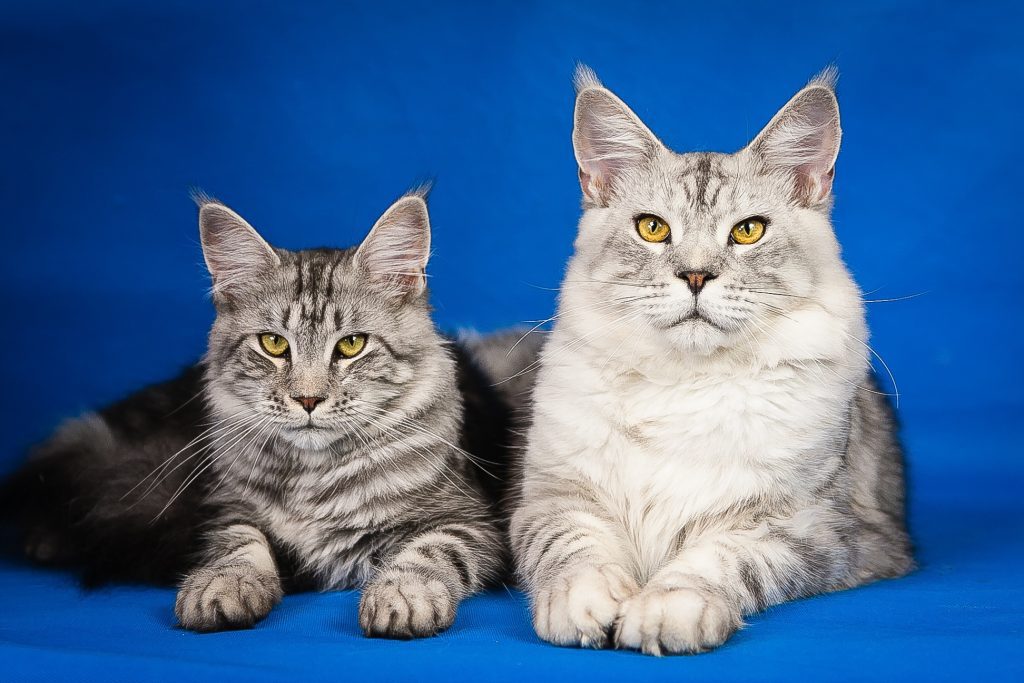
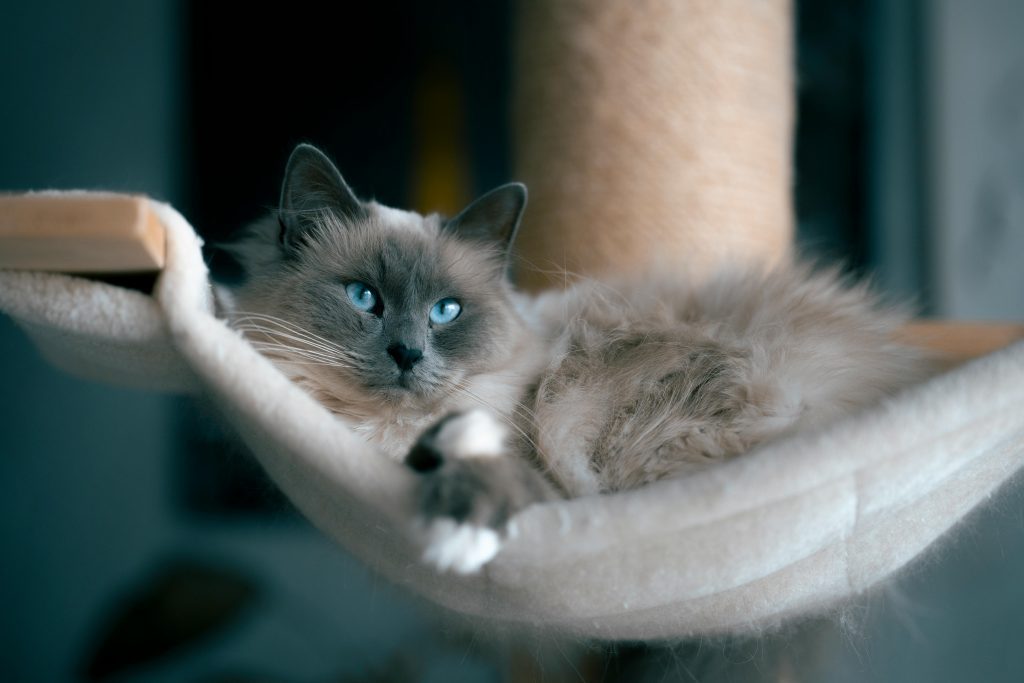
Picture two littermates with the same spotted coat. One is halfway up the curtains at 6 a.m.; the other is flopped beside you on the couch. Same parents, same litter, same “Bengal Ragdoll mix” label.
There’s no breed standard, and nobody has studied how this cross turns out. Some traits flip like coins: long coat, pointed pattern, white spotting. Others, like size and energy, depend on many genes plus how the kitten is raised, so they tend to land somewhere between the parents, with a lot of spread.
If you want a default, expect a medium-to-large, athletic cat that’s busier than a purebred Ragdoll, and let the parents’ temperaments move that guess up or down.
- Energy is the biggest temperament unknown. Plan for the busy end.
- Coat and eyes follow what the parents carry. Blue eyes mostly come with the pointed pattern.
- Health risks don’t cancel out. HCM (hypertrophic cardiomyopathy, a heart-muscle disease) is a concern in both breeds, and the Ragdoll variant is dominant. PRA-b (inherited vision loss) and PK deficiency (inherited anemia) can ride along from the Bengal side as carriers.
- Price should follow paperwork. Pay for proof.
The household scenarios below are composites: typical situations, not specific cats.
I kept the hook and the bullet list, and added only the “default” sentence and the three term definitions. The composites note stays at the end here, so nothing is left for you to place. If you’d rather have it right before the first scenario in the Family section, you can move it there without changing anything else.
You Might Also Like
Why No Two Bengal Ragdoll Mixes Turn Out Alike
Three things make littermates differ. Single-gene traits like coat length and the pointed pattern are recessive, so in a first cross they often stay hidden as carrier genes and only show up when two crosses are bred together, or when the Bengal parent happens to carry them. Many-gene traits like size and energy usually land somewhere between the parents, with plenty of spread. And a kitten’s friendliness is shaped by its father and by how it’s raised in weeks 2-7.
A 1986 Animal Behaviour study by Turner and colleagues found that a kitten’s friendliness toward people was partly explained by its sire. That came from a colony of ordinary cats, so treat it as a signal, not a rule, but it’s why hearing about the father is worth asking for.
A Bengal Ragdoll mix is a crossbreed, not a hybrid. In cat circles, “hybrid” means wild-by-domestic, and most pet Bengals are four or more generations from the Asian leopard cat, so this is normally two domestic cats. If the Bengal parent is F1-F3, ask more questions. Sellers usually list these kittens as “Ragdoll x Bengal.”
Personality: Energetic, Mellow, or Somewhere in Between
Bengal Ragdoll mix personality is a range, centered somewhere between the two parents, and looks won’t tell you where a kitten lands. At the Bengal end, a kitten climbs, invents games, and wants to be part of whatever you’re doing. At the Ragdoll end, it plays in bursts, then settles beside you. A Finnish owner survey supports the gap: Bengals ranked among the most active breeds and Ragdolls among the least. That data is owner-reported, from one country, and not tested on this cross, so it shows the poles, not a forecast.
Coat and eye color come from different genes than activity level (my genetics reasoning, not a finding on this cross), so a plush, blue-eyed kitten can still climb and demand play. The same survey found that across breeds, low contact-seeking tracked low activity and long hair. That’s breed history, not proof a long-coated kitten will be calmer.
The Ragdoll’s famous go-limp-when-picked-up habit is a poor test, because a still cat may be relaxed or frozen with stress. The survey authors also suggest that breeding for easily handled cats may have nudged Ragdolls toward seeking less contact, so calm isn’t the same as cuddly. A Bengal-leaning kitten will likely wriggle off either way. Look at the body:
- Relaxed: loose body, soft or slow-blinking eyes, loose tail, stays when you stop holding.
- Frozen: stiff body, wide pupils, ears sideways or back, tail tucked, no blinking, gone the second you let go.
Temperament also depends on both parents and on how the kittens were raised. Ask what happened in weeks 2 to 7: who handled them, how many different people, and whether they grew up in the house. Then, when you visit, treat these as clues, not guarantees:
- How the mother reacts to a stranger.
- Three minutes of wand play: does the kitten chase, persist, and recover after a miss?
- Pick-up: does it squirm or settle?
- Recovery after a sudden noise.
Whatever you get, a ritual like wand play before dinner keeps the energy pointed somewhere useful. So plan for the energetic end. If you get the mellow one, you’ve over-prepared. If you plan for mellow and get the busy one, you’re rearranging your furniture.
You Might Also Like
Birman Ragdoll Mix Cat: Why Littermates Can Turn Out Totally Different
Coat and Eye Color: What the Parents Predict

Most first-cross kittens look more Bengal than Ragdoll: short coat, tabby markings, green or gold eyes. Long coat and points (dark color on the ears, face, paws, and tail) are recessive, and most Bengals don’t carry them. Coat length, points, white markings, and eye color are inherited separately, so the parents’ coats are your best clue (my genetics reasoning, not a finding on this cross).
- A Bengal-looking cat can carry two Ragdoll traits it doesn’t show. Long coat and points each need two copies to appear, so a short, spotted first-cross can look all Bengal and still carry both. Pair two first-cross cats, and a plush, blue-eyed pointed kitten can appear.
- The Ragdoll is a known quantity. The Bengal is the variable. A pointed Ragdoll passes on a points gene and a long-coat gene every time, so ask whether the Bengal is a snow and whether it carries longhair. A snow lynx Bengal with a Ragdoll should give all pointed kittens. A snow mink gives about half pointed, and half aqua-eyed mink-type, and a snow sepia should give all mink-type. A standard brown Bengal usually gives unpointed kittens, though brown-looking Bengals can carry the snow gene unseen. A DNA test can settle it: UC Davis VGL lists a Bengal coat color panel, so check what it includes.
The odds below are Mendelian arithmetic, assuming the two genes sort independently and the parents carry what’s listed. Real litters are small and rarely split this cleanly.
| Pairing | Long coat | Pointed | Both |
| Standard Bengal (no hidden genes) × Ragdoll | none | none | none |
| First-cross × first-cross | 1 in 4 | 1 in 4 | 1 in 16 |
| First-cross × Ragdoll | 1 in 2 | 1 in 2 | 1 in 4 |
| Snow lynx Bengal × Ragdoll | none (1 in 2 if the Bengal carries longhair) | all | none (1 in 2 if the Bengal carries longhair) |
- Blue eyes follow points, mostly. Unpointed kittens usually end up green, gold, or hazel. All kittens are born blue-eyed, and the color starts shifting around 4-8 weeks and settles by roughly 3-4 months, so early eye color is a weak clue.
- White spotting is dominant, so a Ragdoll bicolor or van parent can put white on kittens. Rosettes are the opposite: they’re a Bengal refinement built up over generations, so don’t count on them in a first cross.
How Big Does a Bengal Ragdoll Mix Get?
A Bengal Ragdoll mix’s adult size follows the parents’ sizes and the kitten’s sex, not breed averages and not how big it looks at 12 weeks. Littermates can match then, yet finish lean or long and heavy, so size at 8-16 weeks is a weak predictor, especially with a Ragdoll parent.
For a rough estimate, average the parents’ adult weights, then adjust for sex. With made-up numbers: a 16 lb Ragdoll sire and an 8 lb Bengal dam point to roughly 12 lb, with a male likelier to land above that and a female below. That’s midparent reasoning, not data on this cross.
The parent breeds’ typical adult ranges give you the outer edges: Bengal males about 10-15 lb and females 8-12 lb, Ragdoll males about 15-20 lb and females 10-15 lb. Bengals usually reach full size around age 2 and Ragdolls closer to 3-4, so expect gains after the first year.
The scale tells you less than body condition does. On the WSAVA 9-point scale, ideal is usually 4-5: ribs you can feel through the coat without pressing hard, and a waist visible from above. A muscular Bengal-type weighs more than it looks, while a Ragdoll-type’s belly pouch can fool the eye. If your cat sits outside 4-5, your vet can help adjust feeding.
Size is the easy part to watch. The next section covers the inherited health risks both parent breeds carry, which crossing doesn’t cancel.
You Might Also Like
Bengal Maine Coon Mix Cat: Why Littermates Can Look Nothing Alike
Is a Bengal Ragdoll Mix a Good Family Cat?
Yes, if your home works at the energetic end: someone home and awake for much of the day, climbing space, and a daily play slot you’ll actually keep. Take one look-alike kitten and two homes (a composite, not a real cat). With a retired owner around all day, the busy end is a joy. With a dog, a five-year-old and an empty house, everyone out 8 to 5, the same cat is shredding the sofa by month three.
Kids. A quiet cat isn’t always a comfortable one, and an overstimulated Bengal-leaning cat will swat or bite. Teach kids three stop signs: ears flat or sideways, tail flicking or thumping, and sudden freezing. Give the cat an exit the child can’t follow through, and supervise. Floppy isn’t consent, since a cat that goes limp when carried may just be tolerating it. Owners in the Finnish survey placed Bengals toward the higher end for aggression, which is owner-reported but fits the caution.
Dogs and small pets. Swap bedding first, then use a gate or cracked door with treats on both sides, dog leashed. Move on only when both animals eat and settle near the barrier. Birds, rodents and fish need latched lids, covered tanks and closed doors, because a climber with prey drive will reach anything that’s merely out of the way.
Long days alone. Before you leave, play with a wand until the cat catches the toy, then give a small meal. Hunt, catch, eat mirrors how cats naturally wind down, so it leaves them settled instead of wired. Window perches and tall climbing space help fill the hours. Add a second cat only if both cats want company.
If you can’t live with the Bengal end, don’t bet on the Ragdoll end. Adopt a young adult whose temperament has been observed, and ask the foster or shelter how the cat does with visitors, with other animals, and at 5 a.m., and whether anyone has lived with it for at least two weeks.
Health Problems: Heart, Eye and Blood Risks
Bengal Ragdoll mix cat health problems come from the parents, not the cross. The three to know are HCM (hypertrophic cardiomyopathy, a thickening of the heart muscle), PRA-b (progressive retinal atrophy, which causes gradual vision loss), and PK deficiency (pyruvate kinase deficiency, an inherited anemia). Say a seller touts “healthier mixed cats” but has no echocardiogram (a heart ultrasound) or genetic results for either parent. Hybrid vigor can mask a recessive problem for one generation, but it does nothing about a dominant variant, and carriers still pass recessives on.
How the genetics carry over
PRA-b and PK deficiency are recessive. A carrier bred to a clear cat passes the variant to about half the kittens and produces no affected ones. The risk returns if a carrier kitten is later bred to another carrier, and then 1 in 4 kittens is affected.
The Ragdoll heart variant is dominant, so one copy can be enough. In Bengals, no causative gene has been identified, so an echocardiogram is the only screen on that side. Here is how to read a Ragdoll parent’s result (these are the lab’s allele labels):
- N/N: no copy of the variant, so about 0% of kittens inherit it.
- N/HCMrd: one copy, so about half the kittens inherit it.
- HCMrd/HCMrd: two copies, so every kitten gets at least one.
A gene test isn’t a heart check.
The Ragdoll test detects one variant (R820W), and UC Davis VGL lists it as appropriate for Ragdolls and related outcrosses. Some cats show HCM on an echo without the known mutations. HCM is most often diagnosed at five to seven years, but Ragdolls with the variant average about 15 months, so a clear echo at eight months is a snapshot, not a pass. Ask sellers for each parent’s last echo date, the parent’s age then, and the cardiologist’s report.
Don’t wait on these
- Count the breaths. While your cat is asleep and not purring, count chest rises for 30 seconds and double it. A rate consistently above 30 a minute is abnormal, so call your vet the same day. At 40 or more, go in now. Ask your vet for your cat’s baseline.
- Open-mouth breathing or visible effort: emergency vet now.
- Sudden hind-leg weakness, crying, cold paws: emergency vet now. This can be a clot blocking the arteries to the back legs (“saddle thrombus”), a recognized complication of heart disease.
You Might Also Like
Price: What You’re Actually Paying For
A fair price tracks paperwork. “Rare” isn’t a cost. The mix isn’t a recognized breed, and rarity isn’t what you’re paying for. I won’t quote a range here, because prices swing too much by region and breeder to be useful. What you can compare is what each price includes, and what a kitten with no records, no contract, and no health guarantee will cost you later.
There are three tiers:
- Adoption fees: the cheapest way to get vetted, often neutered cats with observed temperament. The shelter’s vet records are your paperwork.
- Unplanned litters: cheaper up front, but thin records. You’ll likely pay for vaccines, neutering, and checkups yourself.
- Planned litters from health-tested parents: the costliest, because a breeder testing two different lines (Ragdoll and Bengal) pays for echocardiograms and genetic tests on top of vet care. That’s the cost worth paying for, as long as you can see the proof.
A kitten at any tier should come with:
- Vaccinations and deworming
- A microchip
- A spay/neuter agreement
- A written contract and health guarantee
- Both parents’ health-test results, as covered above
Meet the mother in person or on live video. For the father, get his papers, test results, and a video, since studs often live elsewhere. Ask about both parents’ temperament, size, and coat, because they’re your best clues to what the kitten will become.
Walk away if you see any of these:
- You can’t meet the mother, even on video.
- A vague Bengal generation (link your F1-F4 guide here).
- “Teacup” claims.
- Kittens available year-round with no waitlist.
- Pressure to pay a deposit fast.
- Photos that fail a reverse-image check.
- Kittens offered before 8 weeks, when they’re still in the weeks 2-7 window that shapes temperament.
Pay more only for proof.
The Short Version
Choose the parents, not the label. Meet the mother, ask for the father’s test results, and plan for the busier version of this cat. If you’re torn between a kitten and a rescue, ask the rescue what the cat is like at 5 a.m., because that answer tells you more than any breed name.
References
Ragdoll Bengal Mix (Bengdoll): Complete Owner’s Guide …
Super Rare Bengal-Ragdoll Mix Is Like a Silky Dream Cloud
Bengal Cat Mixes: Types, Traits & How to Spot One
Introducing the Ragdoll Bengal Mix Cat
Ragdoll Bengal Mix: A Gorgeous Blend of Two Stunning Breeds!
Cannot cope with bengal mix kittens : r/CatAdvice
Ragdoll Bengal Mix – Everything you need to know + pictures
You Might Also Like
Bengal British Shorthair Mix Cat: Traits, Care & Price Guide