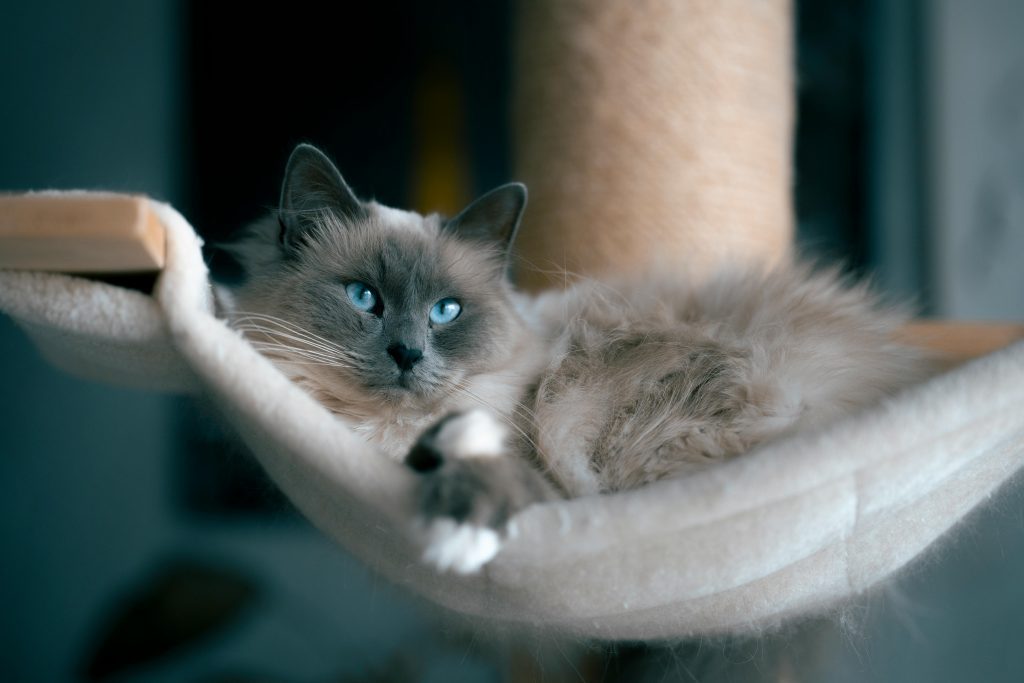
Scroll through Ragdoll kitten listings and the colors blur. Plenty of listings say “chocolate,” yet in photos or poor light, a chocolate and a seal can look nearly identical.
A chocolate point Ragdoll has warm milk-chocolate ears, mask, legs, and tail, lighter than seal, on an ivory-to-cream body. The nose leather (the bare skin of the nose) and paw pads are cinnamon-pink. Eyes are always blue, and kittens are born white, with the points showing within a couple of weeks and deepening well past the first year.
“Chocolate” is the color, “point” the pattern. Before paying for a “chocolate” kitten, check the nose leather first, then the pedigree or DNA. That’s the quick check: nose leather first, paperwork second. Seal and chocolate side by side comes next.
Can Two Seal Point Ragdolls Have Chocolate Kittens?
Yes. If both parents carry the chocolate gene, each kitten has a 1-in-4 chance of being chocolate, and the odds reset with every kitten. A chocolate point Ragdoll is a seal cat with one switch flipped, built in two layers.
The first layer is the pointed pattern, the heat-sensitive, Siamese-type gene that also gives the blue eyes. The second is the brown gene, which is recessive, so it hides behind black until both parents pass it on. A carrier looks seal but carries one chocolate copy, which is why two seal parents can look identical whether or not they carry it. The same gene has a rarer cinnamon version, which is a separate topic.
| Pairing | What to expect |
| Chocolate × chocolate | All chocolate (some lilac if both also carry dilution) |
| Chocolate × seal carrier | Half chocolate, half seal carriers |
| Chocolate × seal non-carrier | All seal carriers |
| Carrier × carrier | 1 in 4 chocolate, 2 in 4 carriers, 1 in 4 non-carriers |
Because the odds reset every kitten, a litter of four from two carriers might hold no chocolates or two. The same logic works in reverse: a chocolate × chocolate litter can’t contain a seal kitten, so a seal in that litter points to a parentage question or a mislabeled parent.
A separate dilution gene turns seal into blue and chocolate into lilac. A color-gene test shows what a cat carries for color. It says nothing about temperament, and health needs its own tests (HCM, below). On a pedigree, ask which color-code system the registry uses. WCF’s standard, for example, codes chocolate point as “b 33.” So yes, two seal point Ragdolls can have chocolate kittens, and it’s no defect or purity issue.
What does the chocolate gene change? Only the color of the points, nose, and paw pads. No study I can find compares chocolate and seal for health or temperament. The biggest Ragdoll health dataset, a 2025 UK vet-records study, couldn’t even analyze coat color because the records weren’t consistent enough. Some buyers assume chocolate means a sweeter cat, but nothing supports that. Those traits come from the parents’ lines, early handling, and health testing.
Related Ragdoll Articles
Blue Point Ragdoll Cat: Types, Traits, Price & Photos (2026)
When Do Ragdoll Kittens Get Their Color?

Ragdoll kittens are born white. The pointed gene makes a heat-sensitive pigment enzyme that only works in cooler tissue, and the womb is warm throughout, so no color forms. After birth, the ears, nose, paws, and tail darken first, while the warm trunk stays pale.
Breeders commonly report a timeline like this:
- First 1-2 weeks: faint shading shows on the ears, nose, paws, and tail.
- Around 3-4 weeks: chocolate and lilac become distinguishable from seal and blue.
- 8-12 weeks: the color is clearly evident.
- Up to about 2 years: the points keep deepening.
That timeline is breeder-reported rather than from a study, and individual kittens run faster or slower. A chocolate-versus-seal call before about four weeks is shaky, but by 8-12 weeks the color itself is readable. What no photo can show is carrier status: a seal carrier looks seal, and only a color-gene test reveals it. To verify a kitten’s color, ask for the parents’ colors, the kitten’s color-gene result, and photos taken at several ages.
Are Chocolate Point Ragdolls Rare? What to Ask Before You Pay
“Less common” is the honest phrase, but I know of no public color-frequency data. Compare two listings for chocolate Ragdoll kittens. One comes with paperwork. The other has a glossy photo and “only two left, deposit today.” Same claim, different proof.
Before you agree on a price, ask for:
- Pedigree with color code: it shows the parents’ colors on paper.
- Color-gene DNA for the parents and kitten: carrier status never shows by eye.
- Each parent’s HCM result (Normal, Heterozygous or Homozygous) on a lab certificate, plus the date and result of the last echocardiogram: UC Davis advises against breeding homozygous cats (more on HCM below).
- The parents’ blood types: mismatched pairings can endanger newborn kittens.
- Registration records: they confirm the kitten is registered as a Ragdoll.
- A written contract covering the health guarantee, spay/neuter terms, and what happens if you can’t keep the cat: standard terms vary by region, so read it before paying.
Color alone shouldn’t explain a higher price. Testing, papers, and whether the kitten is sold as a pet or kept for breeding should. A rushed deposit with no testing is the red flag.
If you’re adopting, a shelter’s “Ragdoll” label usually goes by looks. Papers, microchip history, or a breeder surrender record are the only real proof, and a blue-eyed pointed cat can just as easily be a mix with another pointed breed.
Decide beforehand whether the label matters to you, because it often can’t be confirmed. Kitten photos at eight weeks won’t look like the adult you’re paying for, which is where the next section picks up.
Related Ragdoll Articles
Ragdoll Kitten Growth Stages
Between three and twelve months, Ragdoll kittens go through a gangly, patchy stretch: wispy fur, uneven point color, climbing everything in sight. That’s normal. Here’s roughly how it unfolds:
- 8-12 weeks: The color is readable but still pale. This is the time to get a kitten used to having its paws, ears, and mouth handled, and to the carrier.
- 3-6 months: The fur turns wispy, and the points go uneven. Growth is fast, so give the kitten climbing space and wand sessions before it finds its own.
- 6-12 months: The soft kitten coat gives way to the longer adult one. Puzzle feeders help with the restless energy. Ask your vet about neutering timing and when to switch from kitten food.
- 1-2 years: The points keep deepening, and weight keeps climbing until about age two. In a 2025 UK vet-records study of 21,358 Ragdolls, median adult weight was 4.97 kg for males and 3.83 kg for females. Diarrhoea had a median diagnosis age of about 1.4 years in the same study, so loose stools that don’t clear up are worth a vet visit. If a parent’s HCM result or the pedigree flags risk, this is also the age when homozygous cats usually show severe signs.
- 2-4 years: The color has settled. Obesity had a median diagnosis age of about 3.5 years, so watch portions even if your cat looks fine.
Breeders often cite three to four years to full maturity, while the weight data point to about two. They measure different things: breeders describe the whole cat; the study only body weight. See a vet, not a “teen phase” explanation, for bald patches, redness, scabs, or heavy scratching.
Chocolate vs. Seal vs. Lilac vs. Blue Ragdoll

One feature never settles it, and one photo settles even less. Check several together in daylight, starting with the nose leather, the quickest check.
| Color | Points | Nose leather & pads | Easy mix-up |
| Chocolate | Warm milk-chocolate | Cinnamon-pink | Seal, in lamplight |
| Seal | Deep dark brown | Dark brown | Chocolate, on a young kitten |
| Lilac | Diluted chocolate: pale, pinkish gray | Lavender-pink | Blue |
| Blue | Cooler slate gray | Slate gray | Lilac |
Chocolate has an ivory body with little shading, and seal has a fawn body that often darkens with age. The nose wording follows CFA’s standard.
Standards don’t agree on the nose. CFA and ACFA call a chocolate’s nose leather and pads cinnamon-pink, while GCCF and WCF describe them as matching the points. Ask which standard the breeder’s registry follows, or you could fail a true chocolate on the cinnamon-pink test.
On colorpoints and mitteds, check the nose first. On bicolors and lynx points (points with tabby striping), a pink nose is normal, so lean on ear, tail, and mask color plus pedigree or DNA. A chocolate mitted is the same color with more white, and white feet show pink pads whatever the color. Yellow lamplight can make a chocolate pass for a seal. Cooler climates, winter, and age all darken the points.
Related Ragdoll Articles
Do Chocolate Point Ragdolls Have a Different Personality?
No. Color doesn’t set temperament. Here’s what does. Ragdolls have a reputation for following their people room to room and talking in soft chirps, and that reputation belongs to the breed, not to the chocolate coat. Two chocolates from different lines can act very differently: one trails you to the bathroom, chirping, while the other watches from the shelf instead of the lap.
Two things shape the cat far more than color:
- Sire and dam lines: in a 1995 study, kittens with a friendly father approached and touched a test person faster, so the effect looks genetic.
- Early handling: it matters too, so ask how the litter is raised.
In practice, meet the parents, ask how the sire is with strangers, and see whether the kitten approaches or hides. Even then, “always docile” isn’t a promise. In a 2025 UK vet-records study, behavior problems were recorded in about 4% of Ragdolls and aggression in about 2%. That’s small, but it isn’t zero.
Before you bring one home, weigh three things:
- Long daily absences: a breed known for following its people may not cope well with being alone all day.
- Very small, rough-playing kids: Ragdolls are large, calm cats that may put up with handling that still hurts them.
- Skipped brushing: hair-coat disorders like matting were recorded in 4.0% of Ragdolls in that study, versus 2.6% in an earlier comparable UK study.
How Long Do Ragdolls Live?
Nobody has published a lifespan by color. For Ragdolls overall, the best figure I’ve found is a 2025 UK vet-records study: median age at death 12.85 years, with a wide spread (the middle half died between about 5.7 and 16.1 years), in line with purebred cats generally. It covers UK cats seen by vets, not any one color. Treat any tidy average that doesn’t name its source with suspicion.
Related Ragdoll Articles
How Long Do Ragdoll Cats Live on Average: Indoors Vs. Outdoors Lifespan
Do Ragdolls Feel Pain?
Yes, like any cat. The “Ragdolls feel no pain” myth traces back to the breed’s founder, Ann Baker, and breed history still repeats it. Cats hide pain, and a placid breed makes it easier to miss. Here’s what you might see, and what it could mean:
- Kibble dropping from the mouth, chewing on one side, pawing at the mouth, new bad breath: mouth pain. Dental problems were the most common disorder group in the 2025 data.
- New mats in places she normally keeps clean: she may be too sore to groom there.
- Stops greeting you at the door, or stops hopping onto the sofa arm or the top shelf: pain or illness often shows up as pulling back.
- Litter-box, appetite, or weight changes: a Ragdoll who never talks and starts crying at the litter tray needs a vet.
Any of these is worth a vet visit before anyone says “she’s just getting old.”
Related Ragdoll Articles
Flame (Red) Point Ragdoll Cat: Real Prices & Personality by Age
Ragdoll HCM: What to Ask a Breeder and What to Watch For
HCM, hypertrophic cardiomyopathy, is a thickening of the heart muscle. Ragdolls have their own HCM-linked variant, R820W in the MYBPC3 gene, and the Maine Coon variant is a different one. A DNA test gives one of three results:
- Normal: no copies of the variant.
- Heterozygous: one copy. Carrying it doesn’t guarantee disease, and the risk is less clear-cut.
- Homozygous: two copies. High risk of severe disease, usually at 1-2 years. Two heterozygous parents are expected to produce 25% high-risk kittens.
A negative doesn’t rule HCM out, because the test checks only R820W. Only an echocardiogram (heart ultrasound) shows the heart itself. Ask the breeder for the date, result and name of whoever performed each parent’s last echo. Ask your vet whether your cat should have a baseline echo, and at what age, given its genotype. I haven’t found a single authoritative start age, so that’s a call for your vet or a cardiologist.
Keep it in proportion: heart disease was recorded in about 2% of sampled Ragdolls, versus about 15% for dental disease. Still, know these two signs:
- Breathing rate: at rest or asleep, 15-30 breaths a minute is normal, and consistently above 30 is abnormal. Count for 30 seconds and double it, and don’t count while she purrs. Repeated counts above 30 mean a vet visit.
- Sudden back-leg weakness, crying out, cold or pale paws: this can be aortic thromboembolism, a clot blocking blood flow to the back legs and a known HCM complication. It’s an emergency. Go to a vet immediately, because how fast she’s treated matters.
Chocolate Point Ragdoll FAQs
Are chocolate point Ragdolls purebred?
Yes. Chocolate is a described color in the CFA, ACFA, GCCF, and WCF breed standards, so it’s a color within the breed. Color alone doesn’t prove a cat is purebred. Pedigree and registration papers do.
Will my chocolate kitten turn seal?
No. Points darken with age and in cooler weather, but the genetics don’t change, so a true chocolate stays chocolate. A kitten that “turns seal” was most likely misjudged early, which is why a color-gene test beats a photo.
What’s the difference between chocolate point and chocolate mitted?
The color is the same, but the amount of white differs. A colorpoint has no white, while a mitted has white feet and often a white chin and belly stripe.
How much does a chocolate Ragdoll cost?
It depends on the breeder, your region and whether the kitten is sold as a pet or a breeding prospect. Color alone shouldn’t explain a higher price. The “What to Ask Before You Pay” section above covers what should.
Do they shed?
Yes, more than most people expect, with extra in seasonal changes. In a 2025 UK vet-records study, hair-coat disorders such as matting were recorded in 4.0% of Ragdolls, up from 2.6% in an earlier comparable study, and the paper points to knots under the front and hind legs. Brush a few times a week, especially there, behind the ears, and on the belly.
Is there such a thing as a chocolate tortie Ragdoll?
A female one, yes, and chocolate tortie point is a standard pattern. The orange gene sits on the X chromosome, so torties are almost always female. A male is usually XXY and typically sterile, so a “rare male chocolate tortie, breeding quality” listing is a red flag. A vet can confirm a kitten’s sex but not its chromosomes, so ask for the pedigree and registration papers.
References
Chocolate Ragdoll Cat: Colors, Personality & Care Guide
Chocolate Point Ragdoll the warm, rare one
Chocolate Point Ragdoll Cats: Color, Genetics, and …
All About Chocolate Ragdoll Cats – Sir George
Beautiful Brown Ragdoll Cat Looks Like the Perfect Slice …
Colours and Types
Thinking of a Ragdoll Cat? Here’s Your Complete Guide
Related Ragdoll Articles