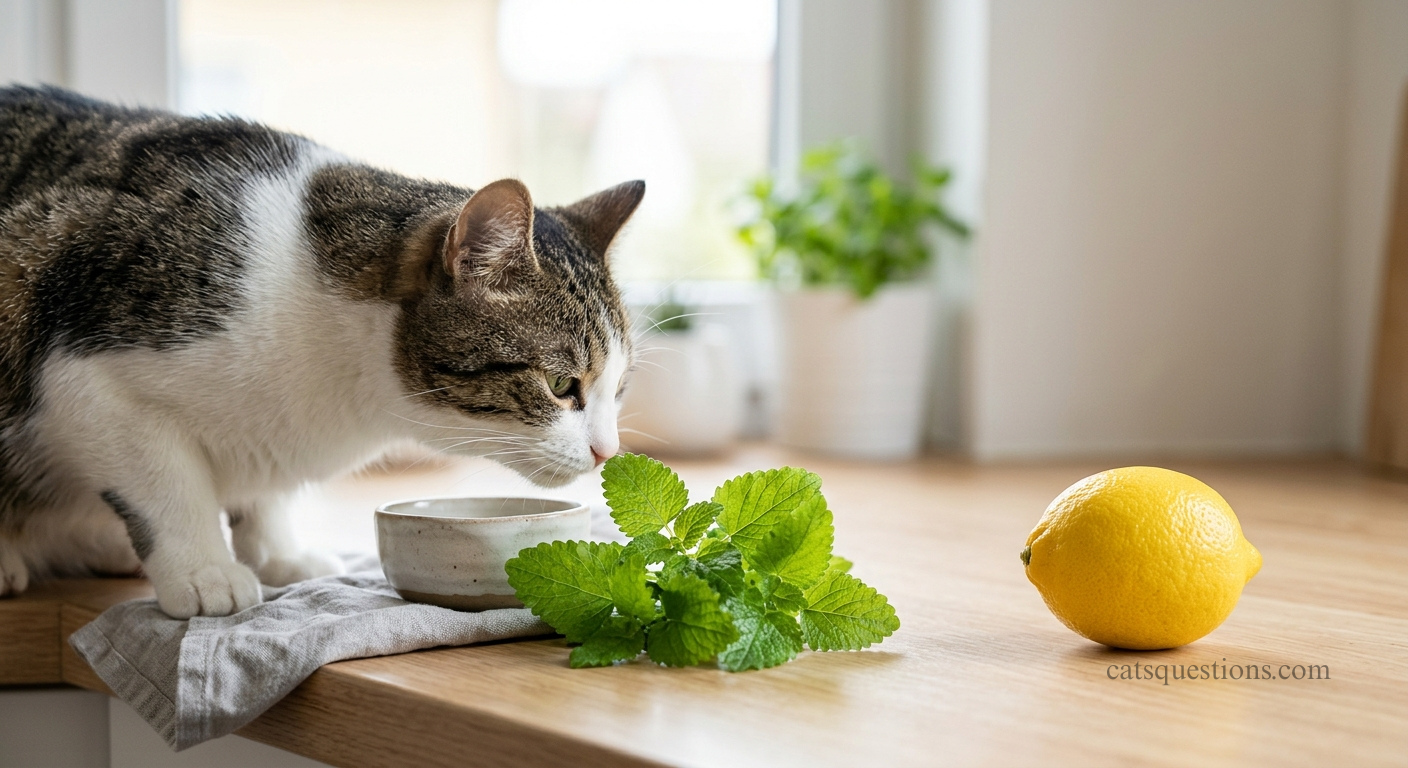
Yes, the plant is safe: the ASPCA lists lemon balm as non-toxic to cats, so a nibble from your kitchen herb pot usually means nothing worse than a mildly upset stomach. Safe to nibble doesn’t mean it does anything, though. I couldn’t find a published trial of lemon balm in cats, and there’s no established dose, so any claim that it calms cats is unproven.
The trouble starts with what gets made from the plant: alcohol-based tinctures, essential oil (a cat licks it off her coat), and multi-ingredient calming chews. Kittens, pregnant cats, and cats on medication also need a vet’s okay before any lemon balm at all (details below).
Same plant, different form. A leaf from the pot is watch-and-wait, while oil or a tincture on her coat means calling the vet now. Already happened? Jump to Warning Signs.
Is Lemon Balm Toxic to Cats? What the ASPCA Label Doesn’t Tell You
The ASPCA’s list is binary, and that’s where it misleads. Catnip sits on the toxic side (vomiting, diarrhea), yet plenty of owners give it freely. A “toxic” listing can mean anything from catnip’s upset stomach to a lily’s kidney failure, and the list rates plants as they grow, not the extracts made from them.
Why is catnip listed and lemon balm not? The ASPCA doesn’t say. My guess is oil chemistry, but that’s a guess. The plant-versus-extract gap runs across the mint family. Garden sage leaf appears on non-toxic lists, yet the Merck Veterinary Manual names sage oil among the essential oils that can cause seizures, alongside pennyroyal and hyssop.
When a cat gets sick after a herb-pot nibble, check the pot before blaming the plant. Sometimes the culprit is metaldehyde slug pellets, a pest spray, fertilizer, or whatever the nursery treated a store-bought pot with. Not sure it was lemon balm at all? Check the plant-ID section first. If she’s already vomiting, drooling, or wobbly, go straight to the next section.
You Might Also Like
My Cat Just Ate Lemon Balm: What to Do Right Now
The rule: a leaf from a pot and a cat who acts normal means watch. If oil, a tincture, or a supplement is involved, call, even if she looks fine.
That last part is the one owners resist. The Merck Veterinary Manual says essential-oil signs can appear within minutes to hours, whichever way the oil got in (licking, skin, or breathing it), so a cat who looks fine right now hasn’t told you much yet.
Watching means checking her at bedtime and again in the morning: is she eating, using the litter box, and walking normally? One soft stool or a single vomit of green plant matter is just plant matter. Call if she vomits more than once, skips a meal, drools, hides, wobbles, or breathes fast or noisily. With oil, also call for watery eyes or nose, coughing, or redness where it touched her.
Call your vet first. If they’re closed, the ASPCA Animal Poison Control line is (888) 426-4435 and Pet Poison Helpline is (855) 764-7661. Both are US lines and may charge a consultation fee. Outside the US, go to your nearest emergency vet.
Don’t induce vomiting. For essential oils, the Merck Veterinary Manual says not to, because of aspiration risk. If oil is on her coat, keep her from licking it while you call. They’ll tell you whether and how to wash her. If she was breathing diffuser mist, move her into fresh air.
How Much Lemon Balm Can a Cat Have?
Decide by form, not by dose. Never scale a dog or human dose by body weight. Cats lack much of the liver chemistry other species use to clear plant compounds (glucuronidation), so essential oils hit harder and weight-based math gives false precision.
| Form | Verdict | Why |
| Fresh or dried leaf | OK if she goes for it; I wouldn’t serve it | ASPCA non-toxic; no benefit shown |
| Tea | A lick, not a serving | No feline data; blends may add other herbs |
| Tincture | Don’t offer | Strength varies by brand, no feline data; a glycerite skips the alcohol, not the data gap |
| Essential oil (diffuser, skin, “melissa” oil) | Don’t use | Absorbed through gut, skin, and lungs; cats are especially sensitive |
| Calming chews | Vet’s okay first | Multi-ingredient, so you can’t tell which one is working |
| Human capsules and gummies | Don’t share | Often blended with other ingredients, and those can be the real hazard |
A lick of plain, cooled tea from your cup is unlikely to matter, but sleep and calming blends often add chamomile or lavender, both ASPCA-listed as toxic to cats. Read the box before you share a sip.
Check the oil bottle too. Genuine melissa oil is expensive and often imitated with cheaper lemon-scented oils, so a bottle labeled lemon balm may be lemongrass, which the ASPCA lists as toxic. Calming collars and sprays built on essential oils fall under the same rule.
If your vet okays a chew, judge the label, not the front: cat-labeled, a full ingredient list with no “proprietary blend,” amount per serving, a third-party quality mark, and batch testing. Ask the maker for a certificate of analysis.
You Might Also Like
Can Cats Eat Pomegranate? Seeds Are the Real Risk (Not the Fruit)
Is Lemon Balm Safe for Anxious Cats?
Nearly everything you’ll read about lemon balm calming cats is borrowed from human trials and lab-animal work. The human evidence is real but thin. A 2021 meta-analysis of 10 trials (Ghazizadeh et al., Phytotherapy Research) found lower anxiety scores than placebo, but the trials were few and their results varied a lot. A 2024 review (Mathews et al., Nutrients) called lemon balm promising and asked for better trials. Both are about people, not cats.
The proposed mechanism is that compounds in lemon balm boost GABA, the brain’s calming signal. It comes from lab and animal work, and no one has shown it in a cat. Chews with several ingredients can’t show which one is working. Owners who give a calming chew also tend to see a calmer cat, partly because they expect to.
The bigger problem is what calm can hide. New restlessness, night yowling, hiding, or litter-box changes can signal pain, a urinary problem, hyperthyroidism, high blood pressure, or cognitive decline. In an older cat especially, new night yowling is a vet visit before it’s an anxiety problem, and a calming chew can delay that diagnosis.
Book the exam first. Bring a photo of every product label (front and back), form and strength, how much and how often, start dates, why you started each one, what changed in her behavior since, and every medication. While you wait, hiding spots, vertical space, a predictable routine, and play before the evening meal are safe things to change.
Which Cats Need a Vet’s OK First?
Risk depends on the cat, so be extra careful with these. Hyperthyroidism (usually cats over about seven). In lab work, lemon balm constituents bind TSH and keep it from reaching its receptor, and in animals lemon balm extract has lowered circulating TSH. Human herbal-interaction references flag a theoretical clash with thyroid hormone replacement, which is a concern for hypothyroid patients, not hyperthyroid ones.
No one has tested it in cats. A hyperthyroid cat’s dose is set by T4 rechecks, so an unmeasured thyroid-active herb makes those numbers harder to read, and if it does suppress the thyroid, it pushes the same direction as the drug.
Some holistic vets use lemon balm for exactly that reason, and a human case report mentions a cat treated with a bugleweed-and-lemon-balm product. Treat that as a conversation for your vet with her T4 results on the table, not something to start on your own. Kittens and pregnant or nursing queens (mother cats). There’s no safety data, so the answer is no.
Kidney or liver disease. Ask your vet first. Those organs clear plant compounds, and cats are already short on that chemistry. Dental or surgical work, or sedative and anti-anxiety medication. Human references say lemon balm might add to the effect of sedatives and anesthetics, so tell your vet about every supplement, product, and chew.
Asthma or other airway disease. Keep every oil and diffuser out of the house. Stop and call for diarrhea, skipping a meal, sleeping through things she’d normally wake for, or any red flag above.
You Might Also Like
Five Lemon-Smelling Plants, Only One Non-Toxic
Five plants smell of lemon, and the ASPCA lists only one of them as non-toxic for cats. Scent won’t tell you which.
| Plant | ASPCA, cats | What it lists | How to spot it |
| Lemon balm (Melissa officinalis) | Non-toxic | None | Low plant with rounded, wrinkled, toothed leaves |
| Lemon verbena (Aloysia triphylla) | Toxic | Essential oils; stomach upset | Shrub with narrow, pointed leaves |
| Lemongrass (Cymbopogon citratus) | Toxic | Essential oils and cyanogenic glycosides (compounds that can release cyanide); stomach upset in cats | Grass blades |
| Scented geranium (Pelargonium) | Toxic | Essential oils; stomach upset, with wobbliness and weakness in larger exposures | Lobed, often hairy leaves |
| Lemon (Citrus) | Toxic | Essential oils and psoralens (compounds that can irritate skin in sunlight); vomiting, diarrhea, depression, possible dermatitis | Citrus tree or fruit |
Leaf shape and the botanical name on the tag are the deciding cues. Square stems and opposite leaves only tell you it’s a mint, and that family includes catnip and lavender, both ASPCA-listed as toxic. Two different plants also get sold as “citronella”: a scented geranium and a true grass. Common names collide too, since lemon balm is sometimes called bee balm, a name that usually means Monarda. Go by Latin names.
So, Which Situation Is Yours?
The plant, yes. Anything made from it, only with your vet’s say-so.
- She nibbled a leaf off an unsprayed pot: watch her through bedtime and the next morning. The signs to look for are in “My Cat Just Ate Lemon Balm: What to Do Right Now.”
- She got into oil, a tincture, or a supplement: call now, even if she looks fine. The numbers and what to have ready are in the same section.
- You want a calmer cat: vet check first, especially for night yowling or new litter-box trouble in an older cat. The visit checklist and what to change at home are in “Does Lemon Balm Calm Cats? What the Evidence Actually Shows.”
- She has thyroid disease or takes any medication: ask your vet before any lemon balm. See “Which Cats Need a Vet’s OK First?”
You Might Also Like

Founder of Cats Question and lead cat care writer, with a background in veterinary education in Bangladesh and a lifelong passion for cats. Dedicated to creating trusted, practical content that helps cat owners make better everyday decisions—guided by real-life experience and inspired by a deep commitment to feline health and wellbeing.