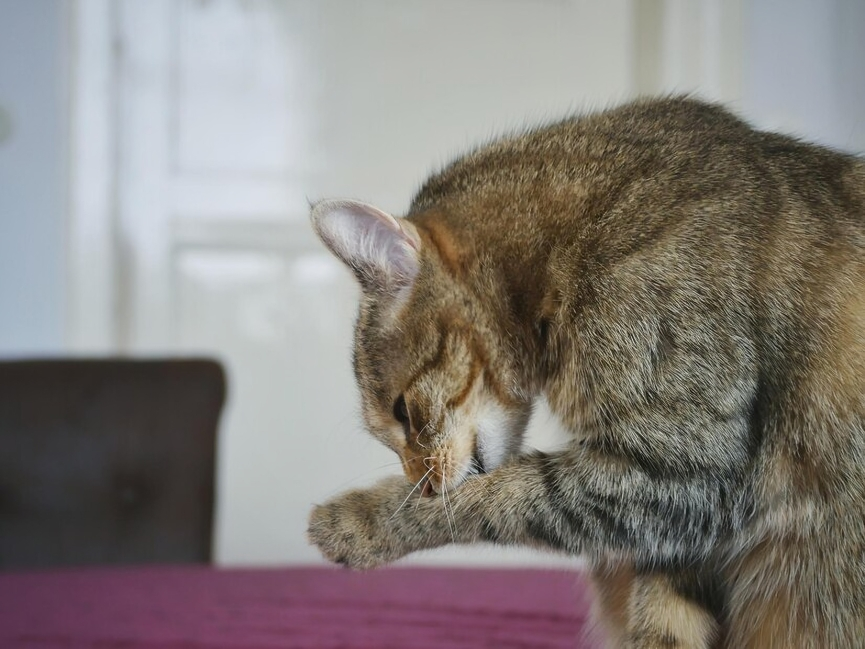
Watch a cat for ten minutes: a paw goes up, gets a few licks, life moves on. That’s not a symptom — it’s just Tuesday. Grooming eats up roughly 30 to 50% of a cat’s waking hours, almost all in short, scattered bursts — that’s how much grooming is normal for a cat.
They barely sweat anywhere except through their paw pads, so a wet paw pulls double duty — it cools them down, and it’s the washcloth their tongue can’t be on its own.
Four licks after breakfast? Nothing to flag. Fifteen minutes on one paw until the fur turns damp and thin — that’s the shift worth watching.
Why Context Matters More Than the Behavior Itself
A cat licking her paws right after a meal is turning a licked paw into a washcloth — a few deliberate swipes over the muzzle and whiskers to clear away food residue and scent, the same instinct that has her wiping down her whole face afterward.
What most explanations miss: this ritual isn’t hardwired from birth — it develops with age. Kittens start self-grooming around 3 to 4 weeks old, fumbling and inconsistent at first, and are usually doing it with adult-level fluency by 6 to 8 weeks. (Worth double-checking these week ranges against a current vet source before publishing — they’re widely cited but not from one single authoritative body.)
Context reshapes the meaning further. That bedtime lick-and-rub — the one where she nuzzles a damp paw against her own head before curling up — is a settling-in ritual, not something to worry about. After the litter box, the same motion is pure cleanup instinct: one gesture, several stories.
Licking vs. Biting: Why the Difference Matters

Cat biting paws gets treated as grooming turned up a notch. But licking and biting come from different root causes — one’s mechanical, one’s diagnostic — and blurring them means missing what your cat is actually telling you.
Normal grooming-bites:
- Brief and purpose-driven
- Aimed at working loose a mat, or dislodging litter or a burr
- Stop the moment the debris is gone
Concerning biting looks different. It’s repeated, fixed on one spot — often a single toe, gnawed at for days in a row — and comes with visible change: hair loss, redness, a patch of fur worn down to stubble. Vets call this pattern “barbering” when a cat does it to itself.
So — is it normal for cats to bite their paws while grooming? Usually, yes, as long as it’s occasional and mechanical. If that’s what you keep seeing, though — my cat keeps licking and biting her paws, on repeat — that fixation is rarely aggression. It’s how cats respond to localized pain, itch, or irritation: a foreign object, a flea bite, a sore toe worth checking for. Which raises the next question: does it matter which paw, or how many?
More Cat Questions, Answered
One Paw or All Four?

Most advice treats “why does my cat only lick one paw” as the reassuring version — probably nothing, don’t worry. Flip that assumption. Location, not intensity, is the faster diagnostic clue, and single-paw focus is the faster case to solve, not necessarily the smaller one. A splinter caught early is urgent precisely because it’s localized and progressing — findable isn’t the same as minor.
One paw only: think local, physical cause.
- Splinter, ingrown claw, insect sting, torn nail, or localized infection
- Check the paw itself — between the toes, the pads, the nail bed — before touching diet or environment
All four paws, roughly even: think systemic.
- Environmental allergies, flea allergy dermatitis
- A contact irritant like new litter or a cleaning product
- Stress-driven overgrooming
Speed matters too: sudden fixation on one paw suggests injury; licking that spreads gradually across paws points toward a developing allergy. A grass seed lodged between two toes and hives breaking out across all four pads are both “excessive licking” on paper — but they’re not the same problem, and they don’t call for the same fix. If your cat keeps licking between his toes on just one foot, start there.
Sore Toes: What Paw Pain Actually Looks Like
Paw pads are sensitive skin — they crack, burn, and get infected just like anywhere else on the body, and “sore paws” can mean several different things. Naming what you’re seeing gets you closer to a fix:
- Interdigital cysts or furuncles — swelling and pain specifically between the toes, usually infection working into the tissue there
- Plasma cell pododermatitis (“pillow foot”) — rare, but distinctive: soft, swollen, sometimes ulcerated pads. Some studies put the FIV overlap in diagnosed cats as high as half, so a swollen paw pad is worth flagging as a reason to test for FIV, not just treat as a surface problem.
- Environmental damage — hot pavement, ice-melt chemicals, rough terrain crack or burn pads directly
- Claw problems — broken, split, or ingrown claws bring a sharper, more localized pain
Gently spread the toes and look for a firm lump, a patch of discoloration, or a pad that’s soft and warm to the touch — that’s the difference between “watch it” and “call the vet today.” If you’re asking why your cat’s paws are sore, or you’ve just noticed one looking puffy, the paw itself usually has your answer. Physical causes are the easier half of this. The harder question is what’s going on once the vet rules out everything physical.
When Grooming Becomes a Problem
Can stress make my cat lick its paws? Yes — but it’s diagnosed far more often than it actually occurs. Vets treat stress-driven overgrooming as a diagnosis of exclusion: something to land on only after medical causes are ruled out, not assumed upfront.
The numbers back that caution up. In a small JAVMA study of cats referred for suspected stress-driven overgrooming, roughly three-quarters turned out to have a diagnosable medical cause once properly tested, and only about one in ten were true stress-driven licking, full stop. The rest had a mix of both — a medical issue with a behavioral overlay — which means almost none of the cats in the study were licking for purely psychological reasons.
Genuine stress triggers do exist:
- Household change — a move, new furniture, a shifted routine
- Boredom or under-stimulation
- Multi-cat tension
- New people or pets in the home
Breed plays a role too — Siamese and other Oriental-type cats run a higher predisposition toward compulsive overgrooming, which is worth knowing if you own one and triggers alone don’t seem to explain what you’re seeing.
Ruling out the medical side usually starts simple: a skin scrape or flea comb to check for parasites, sometimes a food-elimination trial if allergies are suspected. So if you’re wondering why your cat is obsessively licking her paws, rule out the body before you settle on the mind.
More Cat Questions, Answered
Special Cases: Kittens, Senior Cats & Declawed Cats

Same behavior, different life stage, different story.
Senior cats
Large-scale studies estimate 70–90% of cats over age 12 show signs of arthritis, with joint changes detectable as young as six. So senior cat licking paws — even with no limp in sight — is often a quiet pain signal. If you’re asking why does my old cat lick her paws so much, joints belong on the checklist before anything else.
Declawed cats
A published comparison of 274 cats, roughly split between declawed and not, found declawed cats significantly more likely to show pain-related behaviors — excessive paw licking or chewing, litter box avoidance, increased aggression. That’s the same barbering pattern covered above, just with a surgical cause behind it. Declawed cat chewing its paws reflects a documented aftereffect of the surgery, well beyond “just a nail trim.”
Kittens
Kittens aren’t skipping the ritual; they’re still building it. Self-grooming commonly starts around 3–4 weeks old — clumsy, incomplete swipes — and sharpens into adult-level competence by roughly 6–8 weeks. (Worth confirming these week ranges against a current vet source before publishing.) Inconsistent licking at this stage is normal development, not a sign anything’s wrong.
When to See a Vet: Green, Yellow & Red Signs
Most paw licking is background noise, not an emergency — but knowing which category you’re in beats guessing.
- Green (no action needed): Occasional, brief licking, no skin change, spread across paws or tied to something obvious like a meal or the litter box.
- Yellow (monitor and adjust): More frequent, or focused on one spot, but skin’s still intact. Watch a few days — check for debris, ease stress triggers — before doing more.
- Red (see a vet promptly): Bleeding, raw or broken skin, limping, swelling, or a sudden behavior shift.
Pair a Red sign with which paw’s involved, and you’ve got a faster read: Red on one paw usually points to something localized and urgent — a splinter, a torn nail; Red spread across all four usually means something systemic is flaring. Once skin breaks, the itch-lick cycle — where licking worsens the itch, which triggers more licking — tends to feed itself rather than fade. Cat licking paw until it bleeds, or a cat paw raw from licking, isn’t a wait-and-see situation — that’s when should I take my cat to the vet for licking paws, answered plainly: today.
Most of the time, though, it’s still just Tuesday — a cat doing what cats have always done, ten quiet minutes of paw and tongue and nothing to worry about. The paw only needs your attention when it stops being background noise and starts being the story.
Sources
Why Do Cats Lick Their Paws? Can it Become Excessive?
Why Is My Cat Licking Its Paws? Understanding Causes …
Cat Licking Paws: Normal or Not? Causes | Mao Hou Yuan
Why Do Cats Lick Their Paws After Eating?
Why Pets Lick and Chew Their Paws
Is Your Pet Overlicking? Exploring The Reasons Behind …
Why do cats lick their paws after eating even when they …
More Cat Questions, Answered

Founder of Cats Question and lead cat care writer, with a background in veterinary education in Bangladesh and a lifelong passion for cats. Dedicated to creating trusted, practical content that helps cat owners make better everyday decisions—guided by real-life experience and inspired by a deep commitment to feline health and wellbeing.