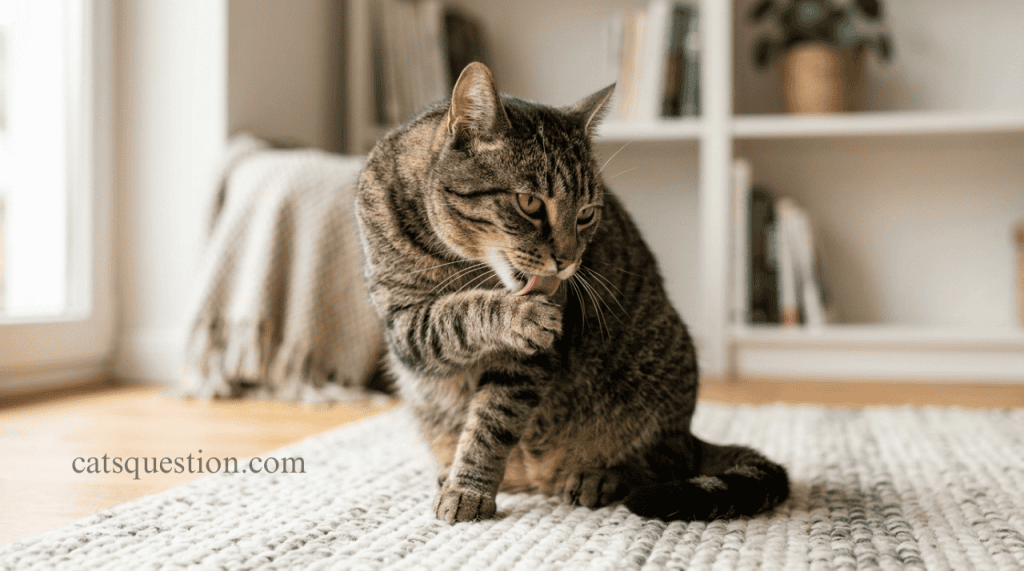
Watch a cat knead — that slow press-and-release against a blanket or your lap — and you’re watching the root of cat kneading behavior: kittenhood muscle memory still running. It starts as a nursing reflex (more on that below) and, in most adult cats, settles into pure comfort. That’s the mechanical half of why cats knead.
The other half: scent-marking. Kneading blankets — or you — doubles as claiming territory and showing affection in one motion. Frequency swings wildly cat to cat, which is why so many owners end up wondering if their cat’s kneading is normal — a few seconds before a nap, or minutes of full knead-and-suckle on fabric, both sit well within normal range.
Below: what the different kneading “dialects” actually mean, how it changes as your cat ages, and when claws-out kneading is worth a second look — not just a range to fall inside.
Why the Instinct Exists in the First Place
Kneading isn’t a single-cause behavior — it’s likely three instincts stacked on each other, and behaviorists still debate whether the nesting piece below is a real inherited behavior or a story we’ve layered onto it after the fact. The nursing reflex is the clearest thread: kittens knead a mother’s belly to trigger milk letdown, and in most adult cats the motion outlives its job, turning into self-soothing.
Layer in nesting carryover — wild feline ancestors trampled tall grass flat before lying down, and a cat pressing paws into a blanket is running the prep-the-nest motion, minus the grass. Then there’s scent-marking.
Cats carry scent glands between their toes, not just on the paw pads, so kneading a favorite spot may double as quietly claiming it. Three theories, one motion — the honest answer to why cats knead (and make biscuits) is: it’s likely all three at once.
Related Cat Articles
Why Do Cats Lick Their Paws? Normal Grooming vs. Warning Signs
What Different. Kneading “Dialects” Actually Mean

Kneading looks the same every time, but what rides along with it changes the meaning:
- Blanket, then circling down — pure nesting instinct, nothing else going on.
- On you, with purring — the closest thing to a contentment readout cats give; at night it reads as a “stay close” bonding cue, not restlessness.
- With drool — a slack jaw from deep relaxation. Only worth a vet mention if it’s new or heavy, since that can also point to dental pain or nausea unrelated to kneading.
- With suckling on fabric — more compulsive, tied to early weaning, most often seen in Siamese and other Oriental breeds.
- Blending into treading or mounting — hormonal, especially in unneutered males.
Read the context, not just the paws, and the puzzle mostly solves itself — a blanket session and a lap-purr aren’t asking the same question. Those in-the-moment reads shift, too, as your cat ages.
How. Does Kneading Change as Cats Age?

Kneading tracks a cat’s whole life, not just its kittenhood. At the kitten stage, that nursing reflex (see above) is still pure function — no comfort involved yet. By adulthood, it flips personality-dependent: some cats knead nightly, others barely at all, and breed has little to do with general frequency — though the fabric-suckling variant above is the one exception.
Do cats knead less as they get older? Often, yes — it tapers naturally in senior cats. But a sudden stop, or a wince mid-motion, points more to joint pain or arthritis than aging out of the habit; kneading loads pressure onto paw joints.
Declawed cats may knead differently, or skip it, from residual paw sensitivity — an angle most articles never mention. No single event — not a house move, not a new pet, not spaying or neutering — rewires this overnight.
Is Cat Kneading Normal? Green, Yellow, and Red Signs
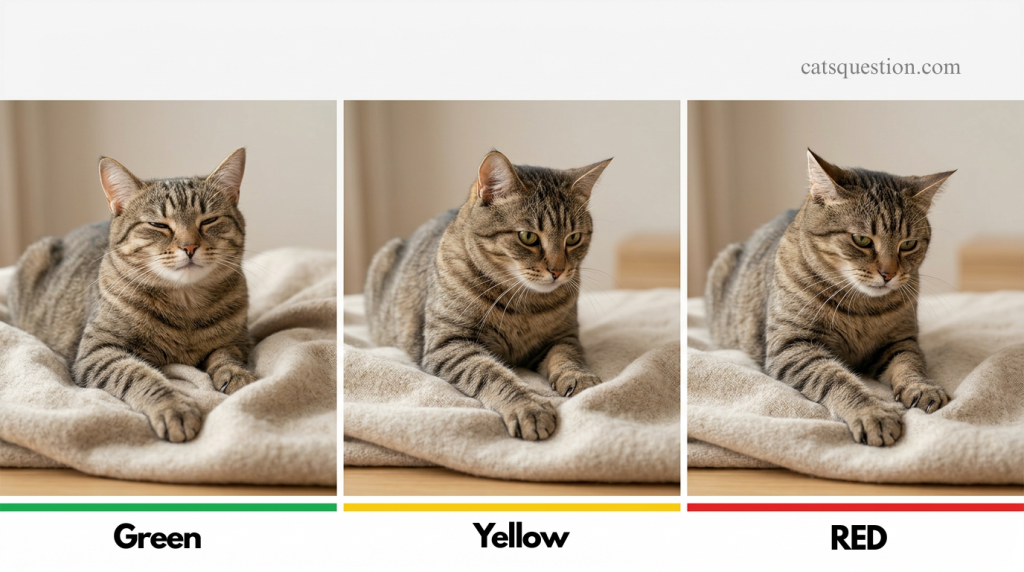
Almost all kneading is normal — the decision point isn’t the behavior, it’s whether it changes:
- Green: purring, half-closed eyes, a relaxed tail, kneading before naps or on soft surfaces with trusted people. Nothing to flag.
- Yellow: a sudden jump in frequency or intensity, new fabric-sucking, or heavier vocalizing alongside it. Worth watching for a week or two — if it’s still climbing or a new symptom joins it, that’s your cue to call the vet.
- Red: hesitation or apparent pain mid-motion, sucking that turns into eating fabric, or an abrupt shift in an older cat. Worth a vet call.
Claws-out kneading or the occasional drool session, on their own, aren’t red flags — plenty of perfectly healthy cats do both for life. And “my cat thinks I’m their mother” isn’t literal; it’s shorthand for an automatic comfort response, not real recognition.
Match what you’re seeing to green, yellow, or red, and you’ll almost always have your answer without needing to overthink it.
Related Cat Articles
Living With a Kneader: Managing the Claws-Out Moments
Claws-out kneading isn’t aggression — it’s a comfort behavior that catches skin because of paw anatomy, not intent. Punishing it doesn’t stop the instinct; it just teaches a cat to be anxious around the person it’s aimed at. Better fix: give it somewhere else to go.
- A dedicated “yes” surface — a looped-pile blanket or cushion holds up far better than a tight weave, and gives claws-out kneading somewhere welcome to land.
- Nail trims and soft nail caps — the two realistic fixes for the sting, without suppressing the behavior.
Declawing isn’t a shortcut: it amputates the last toe bone, not a manicure, and it’s linked to more long-term pain and behavior issues, not less. Trim the nails, redirect the claws, and the kneading stays what it’s always been — affection, not attack.
Cat Kneading FAQs
Do all cats knead?
Most do, but frequency comes down to the individual more than the breed — a few breeds just lean heavier or longer.
Why does my cat only knead me?
It’s less “favorite person” and more which person your cat associates most with safety and routine.
How do I get my cat to knead somewhere other than my stomach?
Give a blanket a head start — drape it over your lap before they climb on, so it’s already the obvious spot to land instead of you.
Should I allow claws-out kneading on my lap?
Your call. A blanket barrier is a fair middle ground if the claws are the issue, not the kneading.
Related Cat Articles