Search “black Ragdoll cat,” and you’ll find plenty of listings — the color you’re picturing genetically can’t exist in a purebred. Purebred Ragdolls are colorpoint cats, carrying the cs gene that restricts pigment to the face, ears, legs, and tail. A solid-black cat can’t carry that gene — which is exactly why it can’t be a standard-conforming purebred.
So what are people actually seeing? Usually a seal point whose coloring has darkened with age or temperature, or a Ragdoll mix crossed with a solid-black breed like a Bombay, domestic shorthair, or domestic longhair.
That’s also why you’ll spot “black ragdoll cat shorthair” listings floating around — genuine Ragdolls are semi-long-haired, so a short coat is itself a red flag for mixed ancestry. Neither CFA nor TICA recognizes solid black in the breed standard. Knowing this upfront saves you from paying purebred prices for a mix.
The Blue-Eyes Paradox: Why Eye Color Is the Real Tell

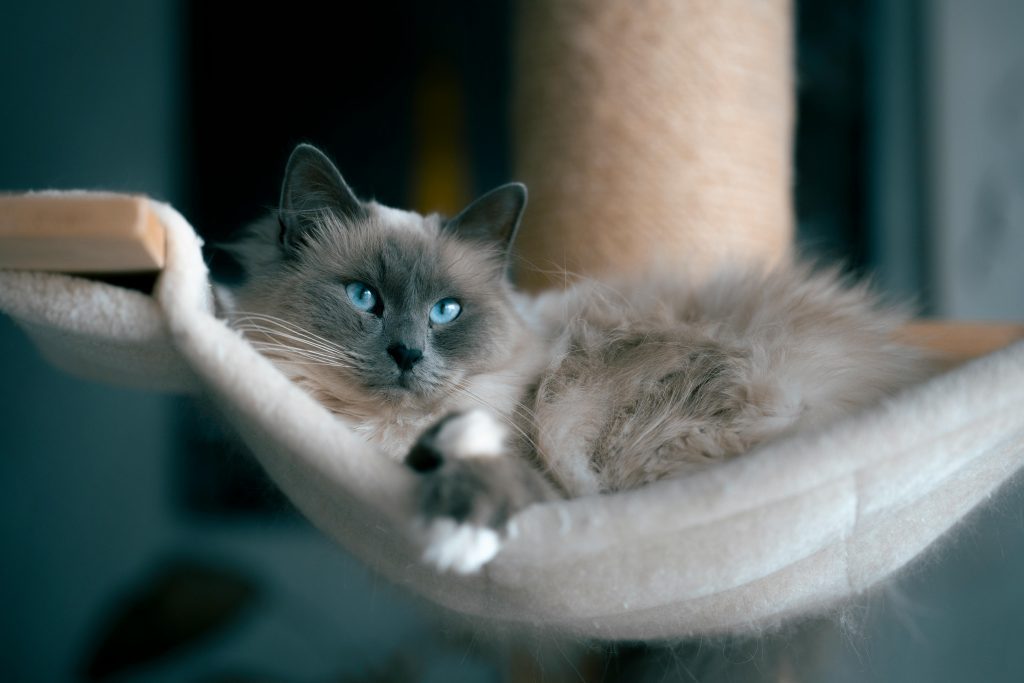
Blue eyes aren’t a separate Ragdoll trait — they’re a side effect of that same cs gene. It doesn’t stop at the coat — it suppresses pigment in the eyes too, which is why colorpoint cats end up with the deep, clear blue breed standards call for, instead of gold or green.
A solid-black cat, by contrast, has unrestricted melanin — so its eyes settle into gold, green, or copper, never true Ragdoll blue. One honest caveat: separate white-spotting genes can occasionally produce blue eyes in solid cats — usually paired with white patches around the face — unrelated to colorpoint. So “black Ragdoll with blue eyes” isn’t just uncommon — genetically, it’s an unlikely pairing outside that one exception.
Related Ragdoll Articles
What Actually Drives the Price? A Real Cost Breakdown
Search “black ragdoll kitten for sale,” and prices swing from $75 to $7,500+ — because you’re really pricing three different animals: a registered purebred, a mixed-breed riding a trendy label, or a rescue.
- Purebred, registered, health-tested: $1,500–$4,500
- Show-quality lines: $5,000–$7,000+
- Pet-quality, from breeders: $1,000–$2,800
- Rare imported patterns: up to $7,500
- Adoption/rescue: starts around $75
- “Black Ragdoll” listings (marketed, usually mixed): $1,800–$5,000 — versus $100–$500 for the same cat sold honestly as a shelter mix. That’s a real premium riding on the label alone.
Budget one more cost most listings leave out: Hypertrophic Cardiomyopathy (HCM) screening. Ragdolls are one of the breeds most predisposed to this heart condition, and a single echocardiogram runs roughly $400–$1,200 — treat it as a required cost, not an afterthought.
Personality: Is It the Coat Color, or the Breed?
That famous Ragdoll temperament — floppy, affectionate, dog-like devotion — comes from decades of selective breeding for the trait itself, not from any coat color. A black Ragdoll cat’s personality depends on how much actual Ragdoll ancestry it carries, plus early socialization — pigment has nothing to do with it.
The folklore runs deep, though. A 2012 UC Berkeley survey found owners reliably assign traits by color — orange cats “friendly,” white or tri-color cats “aloof,” black cats “unlucky” or standoffish — yet the lead researcher found little evidence these differences are real (Petplan). A 2022 Mexico-based study backs this up: no statistically significant personality differences across coat colors, though small sample sizes limited the findings (ResearchGate).
There’s one genuine biological thread worth flagging as speculative, not settled: melanin and neurotransmitters like dopamine share a synthesis pathway, hinting at a pigment-personality link worth watching, not relying on (NIH). So judge the cat’s lineage and upbringing — not its coat — when predicting Ragdoll temperament. That covers what shapes the cat’s personality; what shapes its body takes a lot longer than most new owners expect.
Related Ragdoll Articles
Ragdoll Cat Colors and Patterns: The Genetics Behind Every Shade
Size, Growth & Male vs. Female Differences

If your Ragdoll’s first birthday has come and gone and it still looks like a kitten wearing an adult’s coat, that’s normal — this breed grows into itself the way a puppy grows into its paws, several sizes at a time. TICA puts fully developed males at 15–20 lbs and females at 10–15 lbs, with CFA describing the frame as “large and long, broad and solid, with heavy boning” (Petful).
The male vs. female weight gap isn’t just final size — it’s timeline: males typically finish growing between 3 and 4 years, females between 2 and 3. A 6-month-old Ragdoll can still look like a leggy, narrow-chested kitten, while that same cat at 18 months has usually filled out into a broad, solid frame — and still isn’t done. Breeders sometimes report a 14-lb male at 18 months still packing on another 4–6 lbs before he’s finished.
Why the wait? Growth plates stay open 36+ months, versus 10–14 months in most breeds — which is why vets recommend sticking with kitten formula well past the usual 12-month mark (FurCalc). Size and timeline explain what you’re looking at — next is how to make sure what you’re looking at is actually a Ragdoll.
Related Ragdoll Articles
Buying or Adopting Without Getting Scammed
Searching “black ragdoll kitten for sale” is practically scam bait. Sellers bank on buyers not knowing the standard, then slap a “rare” premium on kittens that are unverified or outright mixed — watch for listings that lean on lines like “extremely rare color, won’t last.”
Protect yourself with a few concrete checks:
- Verify registration yourself — don’t trust a printed certificate. TICA cattery registrations are searchable through TICA’s registered-catteries lookup, and CFA cattery names through CFA’s own index. A legitimate breeder names their cattery and expects you to check (Furrytailragdolls).
- Ask for more than papers — request health and genetic records for the sire and dam, and ask for a live video call with the parents. Be cautious of breeders who’ll only text or email (TICA).
- Question the premium — a steep “rare black” markup from an unverifiable seller is a red flag in itself (TICA).
- Reverse-image-search the photos — stolen kitten photos paired with fake papers are a common trick (Cat Bloom Haven).
If a seller can’t survive these four checks, walk away — no color is worth that risk.
Registries, Cat Shows & What “Unofficial Color” Means for You

Yes, a solid-black Ragdoll is barred from Championship class — but don’t let that word “disqualified” spook you. It’s a cosmetic technicality, not a verdict on your cat’s papers, health, or worth as a pet.
Championship judging measures cats strictly against the written breed standard, and solid black simply falls outside recognized Ragdoll point colors. That’s the whole story — nothing about registration or vet health enters into it.
It’s the wrong ring, not no ring: TICA’s Household Pet (HHP) class exists precisely for cats like this. No registration number required, no written standard to match — judging rests purely on beauty, health, and temperament (TICA, Fanciers).
Your non-standard Ragdoll color cat can still climb the ranks, earning titles up through Master, Grand Master, even Supreme Grand Master in TICA, while CFA hands out “Grand Household Pet” status to cats racking up 200 points across at least six judges. That’s a real, titled path to the show floor — just not the one you expected.
Which Black Ragdoll Buyer Are You? A Decision Matrix
Everything you’ve read so far boils down to one tension: black Ragdoll cats sit at the crossroads of look, papers, and price — and there’s no single right answer, only the right answer for your priority.
| Buyer Type | Price | Verifiability | What You’re Trading Off |
| Budget-First Buyer | $100–$500 (adoption) | Lineage essentially unverifiable | Lowest cost, but no paper trail on ancestry |
| Papers & Pedigree Purist | $1,500–$4,500 (registered purebred) | Fully verifiable via TICA/CFA | Verified lineage means landing a seal or dark point — not true black |
| “Just Want the Look” Adopter | $1,800–$5,000 (marketed as “black Ragdoll,” usually mixed) | Largely unverifiable | Gets the coat and build for less than purebred cost, but adult size and temperament stay unpredictable |
Know your priority first — the right path follows from there.
Related Ragdoll Articles
White Ragdoll Cat: Personality, Genetics & Price (2026 Guide)
References
Black Ragdoll Cat Breed Info: Pictures, Temperament & …
Black Ragdoll Cats: Do They Exist? Colors & Facts (2026)
Rare All-Black Ragdoll Cat Looks Like She’s Been Dipped …
Is it possible to have a black ragdoll?
Black Ragdoll Cat: Facts, Origin & History (With Pictures)
Rare All-Black Ragdoll Cat Looks Like She’s Been Dipped …
Black Ragdoll Cat: Everything You Need to Know

Founder of Cats Question and lead cat care writer, with a background in veterinary education in Bangladesh and a lifelong passion for cats. Dedicated to creating trusted, practical content that helps cat owners make better everyday decisions—guided by real-life experience and inspired by a deep commitment to feline health and wellbeing.